

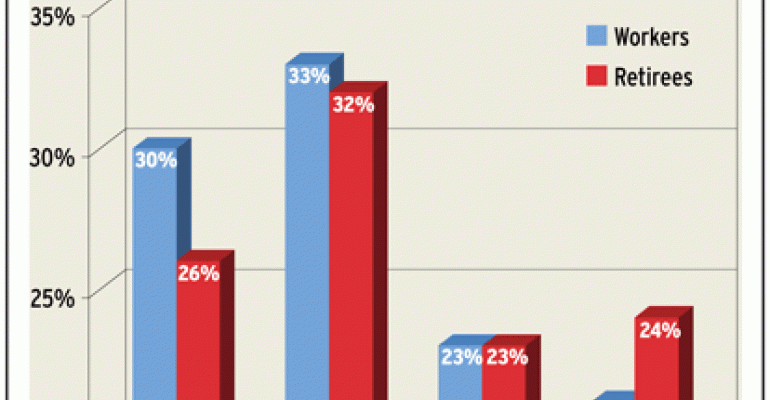
Saving for retirement, and using a financial advisor to provide help in planning for the golden years, are a low priority for American workers, an annual survey by the Employee Benefit Research Institute says today. EBRI’s Retirement Confidence Survey showed that just 21 percent of workers were getting advice from an FA, down from 33 percent two years ago.
Meanwhile, the percentage of workers who feel confident about having enough money for a secure retirement is at just 14 percent, statistically unchanged from a year ago. It remains at the lowest level since EBRI began the annual survey 22 years ago.
“Retirement is not Americans’ major concern. Right now job security and financial security are,” Jack VanDerhei, EBRI’s research director, said during a conference call with reporters. “Many workers report they have virtually no savings and investments.” Indeed, 58 percent of workers with less than $35,000 in income report having less than $1,000 in savings. The percentage of workers who feel they are on track with their retirement savings is just 31 percent, down from 44 percent in 2005.
“Workers are falling further behind, and they know it,” said Mathew Greenwald, co-author of the report.
Scott Mings, associate vice president of Hensley & Mings, a Raymond James & Associates practice in Greenwood, Ind., said he was surprised at the dropoff in Americans using FAs. He said he doesn’t get a lot of pushback on the fees he charges, although questions about fees tend to come up more often during tougher economies. And more people are investing on their own, he added, spurred on by marketing campaigns by large on-line brokerages that encourage a do-it-yourself approach.
The market’s going to have to show people some positive returns. Quite frankly, there hasn’t been a lot of added value from advisors on 401(k)s; maybe that’s a reason for a little bit of the dropoff,” Mings said. “If you’re getting advice but your accounts aren’t growing, then what’s the value of the advice?”
Among the good news in the EBRI report: 81 percent of eligible workers are contributing to workplace retirement plans, a figure that has remained relatively stable over the past three years. That bodes well for both investors and advisors; 64 percent of those who contribute to such plans say they are “very” or “somewhat” confident that they will have enough to retire comfortably on, while just 48 percent of those who don’t contribute to such plans feel that way.
The workplace is a good place for advisors to grab a larger share of the market. Greenwald said, as plan sponsors seek ways to help their employees manage money in 401(k) and other plans. “I think that’s a natural,” he said. “I think there’s various ways a lot of people are going to step up to the plate and try to get more involved in managing money in retirement…It’s just a question of how it’s going to get done. I think we’ll see a lot of experimentation and a lot of success in that area.”
EBRI surveyed more than 1,200 workers and retirees by telephone in January. Pessimism about economic prospects abounded in the report. Just 16 percent of workers and 11 percent of retirees were “very confident” that their investments would grow in value; 8 percent of workers and 10 percent of retirees said they were “very confident” that the economy would grow an average of at least 3 percent a year over the next 10 years.

To offset reduced retirement savings, many workers are resigned to postponing retirement and working longer. EBRI noted that workers who expect to retire at age 70 or older has risen from 12 percent in 2002 to 26 percent this year.
But it may not be an option for many, EBRI warns. While 70 percent of workers expect to work for pay in their retirement years, just 27 percent of retirees report actually doing so. Greenwald said many workers underestimate their prospects for this period.
“In many occupations it’s difficult to get the job done as people get into their 60s,” he said. “So the plan to work longer is positive in some respects but risky in other respects.”